WORLD PEACE WEEK
UN Peacekeeping Operations

United Nations peacekeeping is a unique and dynamic instrument developed by the Organization as a way to help countries torn by conflict create the conditions for lasting peace. The first UN peacekeeping mission was established in 1948, when the Security Council authorized the deployment of UN military observers to the Middle East to monitor the Armistice Agreement between Israel and its Arab neighbours. Since then, there have been a total of 64 UN peacekeeping operations around the world.
The term “peacekeeping” is not found in the United Nations Charter and defies simple definition. Dag Hammarskjöld, the second UN Secretary-General, referred to it as belonging to “Chapter Six and a Half” of the Charter, placing it between traditional methods of resolving disputes peacefully, such as negotiation and mediation under Chapter VI, and more forceful action as authorized under Chapter VII.
Over the years, UN peacekeeping has evolved to meet the demands of different conflicts and a changing political landscape. Born at the time when the Cold War rivalries frequently paralyzed the Security Council, UN peacekeeping goals were primarily limited to maintaining ceasefires and stabilizing situations on the ground, so that efforts could be made at the political level to resolve the conflict by peaceful means. Those missions consisted of military observers and lightly armed troops with monitoring, reporting and confidence-building roles in support of ceasefires and limited peace agreements.
With the end of the Cold War, the strategic context for UN peacekeeping dramatically changed, prompting the Organization to shift and expand its field operations from “traditional” missions involving strictly military tasks, to complex “multidimensional” enterprises designed to ensure the implementation of comprehensive peace agreements and assist in laying the foundations for sustainable peace. Today’s peacekeepers undertake a wide variety of complex tasks, from helping to build sustainable institutions of governance, to human rights monitoring, to security sector reform, to the disarmament, demobilization and reintegration of former combatants.
The nature of conflicts has also changed over the years. Originally developed as a means of dealing with inter-State conflict, UN peacekeeping has been increasingly applied to intra-State conflicts and civil wars. Although the military remain the backbone of most peacekeeping operations, the many faces of peacekeeping now include administrators and economists, police officers and legal experts, de-miners and electoral observers, human rights monitors and specialists in civil affairs and governance, humanitarian workers and experts in communications and public information.
UN peacekeeping continues to evolve, both conceptually and operationally, to meet new challenges and political realities. Faced with the rising demand for increasingly complex peace operations, the United Nations in the past few years has been overstretched and challenged as never before. The Organization has worked vigorously to strengthen its capacity to manage and sustain field operations and, thus, contribute to the most important function of the United Nations – maintaining international peace and security.
______________________________
Australia has had peacekeepers in the field with the United Nations continuously for over 50 years. In Indonesia in 1947, Australians were part of the very first group of UN military observers anywhere in the world, and were, in fact, the first into the field. In the early years, Australia’s peacekeepers were generally unarmed military observers, promoting peace indirectly. Observer missions help create stability, but do not necessarily help end the conflicts. Australian observers took part in a UN operation in Kashmir from 1950 to 1985. The operation continues today, without a resolution of the conflict in sight.

>Since the 1970s,
Australia’s contributions to peacekeeping operations have increased in size and scope. In that decade, and again in the 1980s, Air Force helicopters operated in the Sinai, as Egypt and Israel ended three decades of hostilities. The Air Force was part of the UN Military Observer Group in India and Pakistan from March 1975 until January 1979. No 38 Squadron operated the Caribou and 12 crew members based on rotation at Rawalpindi, Pakistan, and Srinigar, Kashmir, flying re-supply and border patrols. The Caribou, with a fully loaded ceiling of 21,000 feet, was operating in an area where 33 mountains topped 25,000 feet and weather conditions varied from dust to snow. A detachment of Mirage fighters was also based at Tengah, Singapore, from 1971, later moving to Butterworth, Malaysia, staying till 1988. Today the Orion aircraft of No 92 Wing, together with an administrative unit, maintain the Air Force presence in Malaysia.
Another UN Emergency Force was established to supervise the cease-fire in the Sinai following the Yom Kippur War. The Air Force contributed four Iroquois helicopters and 46 personnel at Ismailia on a six-monthly rotational basis from 1976 until 1979. Later, based at El Gorah, the Air Force provided helicopter transport for observers conducting verification and reconnaissance missions in the four treaty zones established as a result of the Camp David Accords of September 1978. The Iroquois helicopters were painted white and bore MFO (Multinational Force and Observers) markings.
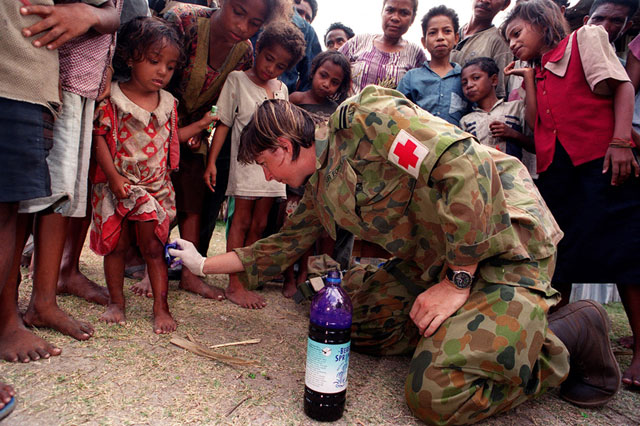
With the end of the Cold War, the 1990s proved to be the busiest decade in the history of multinational peacekeeping. For a period in 1993, Australia had over 2,000 peacekeepers in the field, with large contingents in Cambodia and Somalia. A year later, Australians were in Rwanda, another country to fall victim to genocidal civil violence. This time, the Australian contingent centred on medical staff, who were able to treat many of the local people, in addition to members of the UN force.
Since 1997 Australians have also served in Bougainville, monitoring the long-running conflict between the Papua New Guinea government and the separatist Bougainville Revolutionary Army. Then, in September 1999, Australia led a peace enforcement operation which dwarfed all its previous peacekeeping efforts, as East Timor achieved independence from Indonesia. It also represented a full turning of the circle, for it was in this same month, but 52 years earlier, that the very first Australian peacekeepers were deployed, and the state whose independence they helped bring about was Indonesia itself.
In 1999, Australia sent over 5,500 peacekeepers to East Timor. In 1947, our first group of military observers – probably the first United Nations peacekeepers anywhere in the world – numbered just four.